
How to Measure Your Business Carbon Footprint
(UK Guide for Scope 1, 2 & 3)
- 6mins
- Gemma Branney
Customers, investors and clients increasingly expect businesses to measure and report their carbon footprint. Whether you are responding to tenders, securing investment, or preparing for UK regulations such as SECR, understanding how to measure your business carbon footprint is now essential.
This guide explains how to calculate carbon emissions for your business using the Greenhouse Gas Protocol, including Scope 1, 2 and 3 emissions, what data you need, and how to get started.
How to measure your business carbon footprint (step-by-step)
Follow these steps to calculate your business carbon footprint:
- Follow the Greenhouse Gas Protocol (global carbon accounting standard)
- Define your organisational boundary (financial or operational control)
- Collect activity data (e.g. electricity, fuel, mileage)
- Categorise emissions into Scope 1, 2 and 3
- Apply emission factors (e.g. UK Government DEFRA factors)
- Calculate total emissions in tonnes of CO₂ equivalent (tCO₂e)
- Review, validate and report
When should we start measuring our carbon emissions?
The compliance requirement to report carbon emissions (outlined at the bottom of this blog) will likely come well after you start to getting asked for this data from stakeholders. Below are common situations when companies must start reporting carbon emissions:
- Securing investment (private equity, venture capital)
- Applying for loans or credit facilities
- Pitching for enterprise clients
- M&A processes (especially when selling)
- Applying for grants or scale-up programmes
- Tendering for public sector contracts
What is a carbon footprint?
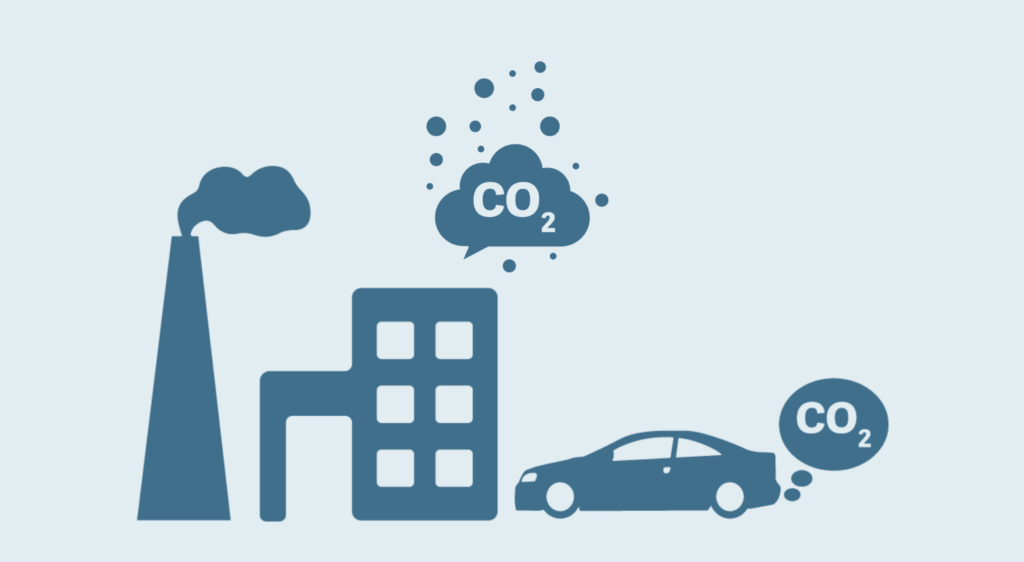
A carbon footprint is the total greenhouse gas emissions caused by your business activities. This includes carbon dioxide, methane and other gases across your entire value chain, from your operations to how your products or services are used and disposed of.
Emissions are typically reported in tonnes of carbon dioxide equivalent (tCO₂e).
Now, we will try to cut the jargon as much as possible (you will notice ENVOLV focus on making sustainability simple and accessible).
What are Scope 1, 2 and 3 emissions?
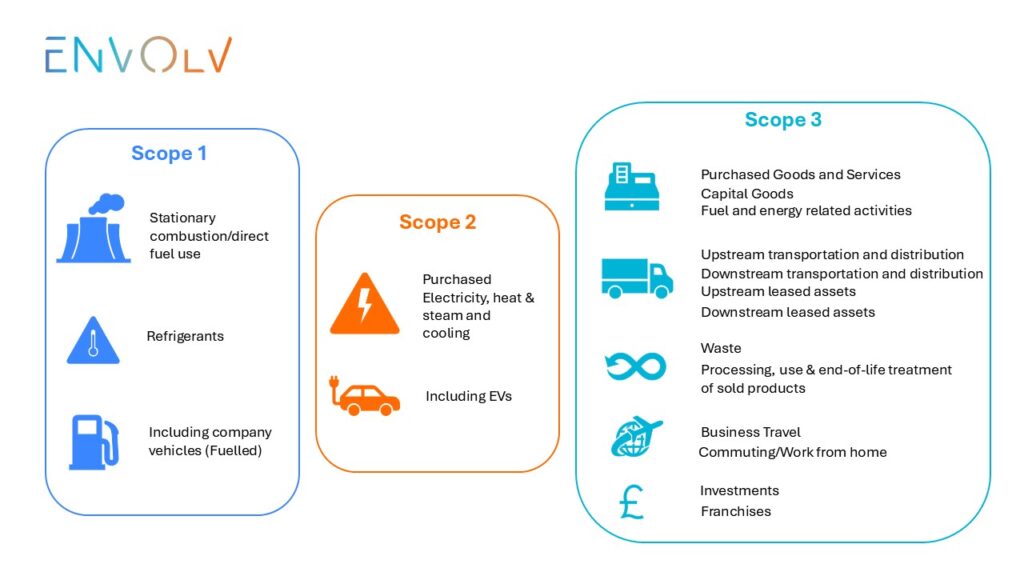
Scope 1 – Direct emissions from owned or controlled sources (e.g. fuel combustion, company fuelled vehicles, refrigerants).
Scope 2 – purchased electricity, heat and steam, cooling. What you use in your buildings (including rented space) and any electric vehicles. You might see the term market-based which is emission factors provided by your specific supplier, and location-based which is the average emission factors for the electricity grid where you are based.
Scope 3 – is indirect emissions. It is more complicated as there are 15 categories which include things like business travel, supply-chain, working from home. Rather than list them all we recommend checking out this handy guide by the GHG Protocol.
What emissions should a business measure (Scope 1, 2 and 3)?
Going from zero to reporting your full carbon emissions is not easy. At ENVOLV we always recommend taking a step-by-step approach and building up to full Scope 1, 2 and 3 (unless you have an urgent demand to do everything instantly).
Often Scope 1 and 2 are more within your control and easier to measure. Scope 3 takes more time, and you need to have more mature data management in place. Advice for Scope 3 reporting can be found in our Scope 3 Reporting Guide.
How do you start measuring your business carbon footprint?
There are some key decisions you need to make before you get started:
- Do we need a carbon reporting platform? Start simple and scale up. Platforms range from £0 up to £30,000 depending on how big and complicated your business is. You can start on a spreadsheet.
- What is in scope? Be clear on what is included and excluded. If data is unavailable (e.g. newly acquired entities), document this transparently.
- What is the boundary of reporting? Define your organisational boundary: Financial control: authority over financial and operating policies, with exposure to risks and rewards. Operational control: authority over day-to-day operations and policies
- Who needs to be involved? The biggest mistake we see is one person owning your carbon reporting and making every decision or judgement, and that includes outsourcing to a provider who doesn’t interact with your business. Good governance means decisions are informed and recorded.
We support UK businesses with SECR, ESOS and investor-grade carbon reporting.
“Gemma built a clear carbon reporting methodology that ensured everyone knew exactly what data was needed and why. This strengthened internal awareness and confidence whilst also improving data quality.”
How do I measure Scope 1 and 2 emissions?
Collect usage data e.g. how many kWh of electricity, MMBTu of natural gas etc. For some businesses this will include generator diesel, LPG, CNG, gasoline, propane – even aviation fuel. Collect the usage data for the whole reporting period.
Plug this data into your carbon reporting tool. That might be a platform or a spreadsheet and choose to source emission factors direct from DEFRA which you can find on the UK Government website.
If you decide to calculate yourself using DEFRA we recommend asking an agency like ENVOLV to check your numbers. Our advice clinics are the perfect place to do this.
We cover Scope 3 in another blog due to the complexity, but we recommend doing Scope 3 in phases.
How to check if your carbon footprint data is accurate?
The first year of reporting feels a little bit more like a dress rehearsal. You will likely have data gaps, and some errors. It will though help you set-up for success in year two and beyond.
But there are somethings you can do for quality assurance purposes:
- Check year-on-year data. Even if you don’t have carbon data for the previous year checking consumption can flag any inconsistencies which signals missing data.
- Use an intensity ratio such as carbon emissions per employee or £ of revenue and compare this to businesses similar in size and operating type.
- Ensure your internal experts get eyes on the data. Your finance and operations teams, will see anomalies and gaps that are not obvious to anyone else.
Easy mistakes to avoid
We see mistakes in carbon footprint data quite often and they are really avoidable:
- Always detail what data is excluded and why.
- If your fuel or electricity is 0 because they are either not applicable or your on a 100% renewable energy tariff, detail this as 0 or not applicable. Otherwise, it looks like an error.
- Avoid jargon you don’t understand. So many companies interchange net zero and carbon neutral when they mean different things (check out our anti-greenwashing guide).
- Some companies only report location-based or market-based electricity. You should report both.
- Don’t set carbon reduction or net zero targets without speaking to a sustainability professional (we give general advice at no charge). We often see unlikely targets, when data isn’t covering the right scopes, there is no transition plan or the term net zero is misunderstood.
When does voluntary reporting change to a compliance requirement?
Compliance thresholds vary, particularly from country to country. In the UK there are two main compliance requirements that relate to carbon reporting:
SECR (Streamlined Energy and Carbon Reporting)
Becomes mandatory if you are:
- A quoted company, or
- A large UK company/LLP meeting at least 2 of 3: ≥250 employees, ≥£36m turnover, ≥£18m balance sheet
ESOS
Mandatory if:
- ≥250 employees, or
- €50m+ turnover and €43m+ balance sheet
Worth knowing
- There are country specific carbon reporting requirements. Establishing horizon scanning tools so you know what is required where.
- Ratings platforms such as CDP, Ecovadis and various supplier score cards require publicly reported carbon emissions.
- New compliance emerges frequently. Stay up to date.
- Greenwashing results in financial penalties, legal disputes, lost revenue and reputational damage.
Final thoughts
For small businesses, carbon reporting is simpler than it first appears. There are free tools, government resources and cost-effective ways to get started.
As you grow, investing in the right processes early will make reporting more efficient and valuable.
Your carbon footprint is not just a compliance exercise. It identifies risks, cost savings and informs strategy.
Get support
If you need support building your carbon footprint or ensuring compliance with UK frameworks, ENVOLV can help design a robust, audit-ready approach.
Book a free initial consultation to sense-check your approach or identify gaps in your data.
FAQs: Measuring a Business Carbon Footprint
Do small businesses need to measure carbon emissions?
Not always legally required, but often expected by clients, investors and lenders. Many SMEs start measuring emissions to win contracts or prepare for future regulation.
What is the difference between Scope 1, 2 and 3 emissions?
Scope 1 = direct emissions, Scope 2 = purchased energy, Scope 3 = value chain emissions.
Do I need software to calculate carbon emissions?
Not necessarily. Many businesses start with spreadsheets using DEFRA emission factors before moving to dedicated platforms as they scale.